PART A : State-of the Current Economic Environment
 |
A-1 Traditional Business– Some Limits
The following comments may be made about traditional business - It is not easy for a company to create a new service, especially in developed countries where competition is rough and where demand has reached saturation in many first-generation industries. Furthermore, the way in which supply meets demand has become less and less flexible. In France, for example, distributors in the food industry control the consumers’ market. In the distribution chain, producers (who include SMEs) have almost now no power to deal with the large distributors, which control the market. About four of these mega distributors control 90 % of the supermarket budget. In this situation, no company can compete. What other choice have little producers except to sell their product in large quantities at the price demanded by the distributors?
Another example of lack of flexibility is demonstrated by the business culture in Japan. The cultural principals of company governance there directly involve banks in the management of companies. The banker as the main shareholder has almost the same power as the manager of the company - he can even take part in management meetings. Is it a good idea to give so much power to bankers over companies when the stock exchange is low? What scope for development can new ideas have in such a context? This may be one of the reasons why the Japanese economy is so sluggish at present.
Problems are often tied to a specific culture or space. In Europe, for example, in most countries (except for Ireland), the tax system has become extremely heavy for High-Tec companies. This prevents managers from deciding to try a new business idea. Thus initiatives become limited.
Another issue a modern economy has to face is the increased power, which has been gained by MNCs[5] in the world economy. For example, Nestlé is said to be more powerful than governments. When companies are that huge how can other companies, or private persons, deal on a level playing field with them? Should not power be a little bit more balanced between market players?
As an illustration we could take the example of a private person needing to borrow money to build a house. He represents the demand. How many opportunities does he have? He will surely contact his bank, maybe a second one in his city, and then probably try to contact a financial services company he saw advertised on TV. As all this will take a lot of time, he will finally resign himself to accepting the first offer of his own bank. In this case, it is hardly possible to consider the supply as flexible - the consumer has, in the end, very little choice. On networks, however, equilibrium between supply and demand is more likely to be reached. Why? The person looking for finance has the opportunity to visit many web sites where finance houses offer their services – all within a frametime of few hours. There are also other possibilities. The person can even call for tender from his home PC. Using E-trade he can prospect for a loan and banks will make proposals to suit his needs. To conclude, business on networks returns power to smaller market players.
A-2 Nothing New About Business Online!
Selling services or products on line is far from being a new concept. It is at least a twenty-year-old technique. We will look at two examples that are not a new way of doing on-line business but that belong to electronic commerce - “Electronic commerce allows market players to do business electronically”.
The SWIFT[6] network provides domestic and international financial data communication, processing services and interface software to financial institutions around the world. In 1997, over 6.153 institutions use SWIFT to communicate with each other 24 hours a day. SWIFT currently operates in 174 countries and processes more than 800 million messages each year with peaks of 3.6 million messages daily. SWIFT has become an integral part of the international financial community. Its worldwide telecommunication network guarantees the rapid, cost-effective, secure and reliable transmission of financial data using standardised messages developed by SWIFT in conjunction with its customers.
Another example of many years old on-line business is given by SITA[7], the Air transport Industry uses GABRIEL Booking Information Data (BID) system. This is a service, which provides on line details on bookings and cancellations. It captures bookings and cancellations made by Abacus, Amadeus, Apollo, Axess, Carmel, Galileo, Gets, Infini, Iris, Kama, Saafari, Sabre, Sertel, System One, Topas, and Worldspan. SITA also provides call centre management and Internet booking facilities to enhance GABRIEL services.
What is new then? Now, the use of the IP[8] based on opened standards that allow all market players even final consumers to communicate with each other, with a simple computer and a modem. All have access to the networks of networks to buy or sell. In addition, the cost of the Internet technology is far lower than previous ones that used proprietary systems like SITA or SWIFT. SMEs are now able to use this technology.
A-3 A Turbulent Environment
The market place has become progressively more complex and turbulent. The following examples have had a strong impact on the worldwide commerce:
·In Asia, during the 1998 crisis large banks disappeared within few days
·There are huge discrepancies on same continent: Ireland has now a high rate of growth and Spain a high rate of unemployment
·There are an overcrowded number of market players making it difficult to identify competitors.
·The year 2000 bug is a threat for all computer systems
·The rapid expansion in software versions is real challenge for employees
·The use of a single currency in Europe of the Euro – although it appears to be a cost saving device for most export companies, at the same time it implies accounting information system standardisation.
With the above factors the current business environment is very challenging for all market players. The question is what is the impact of new technologies on this turbulent environment? Should we consider them yet another threat to companies?
In the environment which is turbulent and where business seems in some ways limited, it is interesting to analyse what is called the “digital economy”[9] by the US Department of Commerce and to look at the impact of this electronic market on the global economy. In France, the expression “netéconomie”[10] is used.
A-4 New Technologies helping changes
The emerging markets based on new information technology are a dream for some enterprises and a nightmare for others. Some businesses can see, for example, their distribution channel challenged by a mere mobile phone. The current environment is favourable to innovations, however, and companies should try to understand which technology will appear and transform their business. For example, the following technologies might have an impact on traditional business.
The New Terminals for the Network
Age:
The Preconfigured Computers: The “plug and play” theory suggests that if you ease the life of users they are more likely to use a technology. Oracle, SunIssue and Internet Challenge have decided to join in a software project that will offer greater simplicity, reliability for electronic commerce[11]. They declared on December 15, 1998, that they would share the source code of key software in an effort to simplify and strengthen their products for people using the Internet. This technology exchange will virtually do away with the operating system underneath new software and is scheduled for release in March 1999. Oracle will produce the industry’s first appliance, which will run on a stripped down version of Sun’s Solaris operating system invisible to the user. The computer will be preconfigured, with an invisibly integrated operating system and database application providing greater simplicity and lower maintenance costs. (The problem with general-purpose operating systems is that when you add applications to them you add “a million and one places for human error”.) This new computer will come out of the box ready ‘to plug and play’, and should attract more people to network computing.
A Universal Cyberphone[12] : The second terminal, which will give access to networks, will be soon in your pocket: Old mobile phones may quite quickly be replaced by a universal cyberphone. A single personal terminal could quickly replaces stacks of cards (cash-card, credit-card, customer card, driver's license, keys and cash) and will be equally useful locally, in shops, entrances as via a GSM, or when connected to a PC or TV. It will require much less processor-power than current "fat" client solutions. The marketing concept is "information at your fingertips".This technology is web oriented because it will allow Intranet/ Extranet login, Internet shopping and set payments, Internet banking, sending /receiving encrypted signed e-mail. In the future, it may be possible to use such terminals for:
·Hospital-to-client applications
· Civil applications (national elections)
·Access to various registers
·Biometrics identification
PS Isables : The last terminal that might influence network life was created in France by France Telecom and is called “PS–Isables[13]. This communication tool will allow the use of telephone, electronic mail (with instant notification without call) and web surfing, as well as the possible use of old Minitel services. This marketing approach should be successful simply because it targets people who would never otherwise use a sophisticated computer.
Networks and telecommunication
technologies
With backbone, GIX and nodes, networks
are expanding the virtual space where people and organisations meet. Electronic
commerce relies on network connection quality. take the practical example
of a company placing an order using the commercial web site of its partner:we
certainly cannot assume that professionals will have the time to wait hours
to receive product details or order forms. Thus the need to improve the
infrastructure.There are many remarks
to be made about this vital infrastructure, and listed below are some comments
on technologies that might improve it.
The infrastructure of Internet, is being built by all kinds of companies such as telecommunications, satellite, cable, wireless, and electric companies to name but a few. They are all competing in order to improve Internet with their own technology. (With their own interests at stake)Nortel, for example, is the Canadian company which first used electrical networks to transmit digital information, which is quite a goo thing in terms of economy.
Other technologies in terms of transmission speed should quickly improve the traffic on the Internet. For instance, France Telecom has developed a new technology called ADSL which stands for Asymetrical Digital Subscriber Line. This technology can be used on normal telephone lines but allows a quality connection close to cable quality. France Telecom will probably soon launch it under the following commercial offer “Turbo Wanadoo”. Unfortunately, its use is limited to a circle of five kms from the telecom centre.
www. Caida.org is a Cooperative Association for Internet Data Analysis. On this forum, one can learn more about the quality of networks transmissions is one of the main subjects.
VPN Virtual Private Network. BULL won the trophée 1998 with its securware VPN. The aim for this tunneling plug and play is for each company to be able to built their own private network in order to secure their transactions. A short survey demonstrated that 68% of managers knew about the concept in the UK and only 30 % in France. The top country is Sweden with 20 % companies that are actually using it.
A-5 Towards A Digital Economy
During the past few years, the United States economy has performed beyond most expectations. A shrinking budget deficit, low interest rates, a stable macroeconomics environment, expanding international trade with fewer barriers, and effective private sector management are all credited with playing a role in this healthy economic performance. Many observers believe advances in information technology, driven by the growth of the Internet, have also contributed to creating this healthier-than-expected economy. Five types of economic activities, which are creating an electronic market, drive this growth[14]:
·There is a real race to build networks such as the Internet. All kind of companies such as telecommunications, satellite, cable, wireless, electric companies are competing in order to improve the networks with their technology. Tests to use water to transmit information are even been undertaken.
·Digital delivery of goods and services, just like software programs, music, and newspapers is increasing
·The retail sale of tangible goods, such as flowers and books is growing rapidly
·Increasing number of households that are buying computers to connect to networks
·Use of Electronic commerce is increasing among businesses
·The Internet is replacing fax, telephone to ensure commercial transactions
Even if the turbulent environment is challenging businesses, as is obviously happening in the US, IT is offering solutions to companies to develop themselves. They actually benefit form this changing environment. We can consider that in terms of exploring new creative business models, what is happening on the American continent, should be scrutinised.
Although the way society is organised and structured in Europe makes it difficult to transfer an exact replica of the American model, it is important to understand that the new technologies are not threatening. If well managed, a company’s information system can be the best tool fully awareness of changes on the market. Companies can take advantage of, and use, what’s happening “outside” to be in advance and anticipate the demand.
A-6 A Challenge to Society: An Emerging Electronic Market
Nowadays, 140 million people are linked to the network (Internet) whether in their house, at work or at University. That many of them connect at least once a week; at least to read E-mails is an important reality. How many people are actually using the networks? In France, 4.2 millions Internet users were listed by the Internet providers association in February 1999. In Japan, where shopping on Internet is becoming a popular activity, there are 12 millions people connected people. Half of them confirm that they have absolutely no fear of buying on-line. Today, the electronic market is no longer an information scientist’s illusion. On the electronic market, millions of people act every single day. The figures produced by the following three well known institutes demonstrate this network business life.
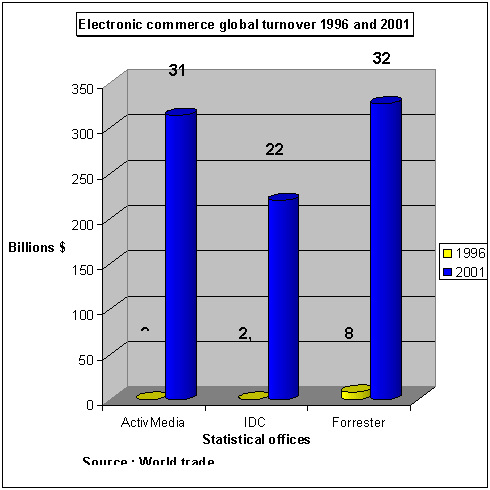
-This chart is an extract of the WTO[15]
(World Trade Organisation) 1998 report on ecommerce-
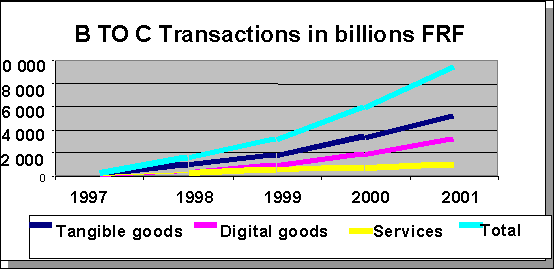
This is an extract of Cegetel report on ecommerce, 1999.
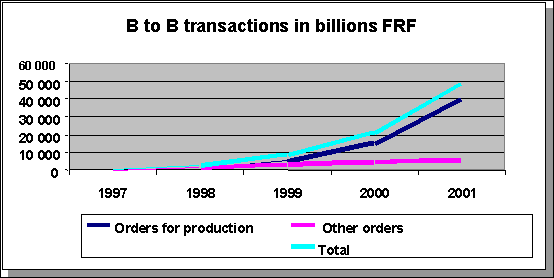
This is an extract of Cegetel report on ecommerce, 1999.
A-7 Information Technology – A Synonym of Local Development
Silicon Valley is currently the most striking example of local economic development in the IT field. The growth of the American economy is based on IT. Even if sometimes people are reluctant to use it, as it is something new and therefore feared as bad for society, it has to be acknowledged that IT is a brilliant way to create new jobs and services.
Electronic commerce is a great challenge and opportunity for local areas. In traditional business scenarios, remote places have very little scope to develop themselves no matter how well the company performs. Local companies have trouble in marketing their product as they are far from business centres. Recruiting is also a hard task. Young people leave to study in large cities and very rarely think of returning to a small community. In France, most rural areas have little economic development.But some rural areas have found a way…
In the electronic market, distance does not matter; it is measured with a “click’ – a company is a maximum of thirty seconds away from the next competitor. SMEs based in local areas can thus gain access to the market with a electronic web site which will help them to be much more present on the market than previously. Although there is a great improvement at the moment, the barriers for SMEs remain the quality and the price of the telecom infrastructure.
To be successful, electronic commerce more than any other kind of business project, needs to concentrate on co-ordinating different skills. Not all, but some of the skills can be found in rural areas in the field of high tech - but they may not have been used formerly because of the distance factor. The common use of networks will help companies to benefit from “remote skills”. Using networks it is easy to have graphic artists work for a company, even if they are physically one thousand miles away.
IT
– Facilitating the Growth of SMEs : As the European Community White Paper
on electronic business recognises, the globalisation of the economy is
nowadays a reality. Huge companies are implementing worldwide strategies
and merging with others when needed. Does this mean the end of the local
economy? According to the White Paper, thanks to IT, it is possible that
this will not be the case. In Europe, there are 16 million SMEs, which
account for two-thirds of the global revenue. The business done on the
network is a new marketplace. The network provides another way to create
a value chain where the size of a company is no longer an obstacle.
SMEs are usually able to develop a strategy to benefit from this new area of opportunity. The skills that must be acquired can be furnished through the SME’s ability to use different sources of knowledge, e.g. other companies, associations, university, business schools, collectives and clubs. Electronic commerce will never be a detached project. The first function is precisely to link different structures into an efficient and professional network. Projects do require different kinds of people that are very rarely all available within SMEs. MNCs do not benefit from these local networks but they usually can afford to hire skilled people at a higher cost.
Local partnership is therefore becoming a key word, which local authorities need to recognise and help. The outcome will, in the short term, be a higher unemployment rate, but in the long run, new jobs will increasingly appear such as net communication, management of cyber-merchandising, customers database management, electronic-commerce law, electronic-commerce project management, electronic-commerce consultancy, on-line advertising counselling, and e-strategy. Thanks to IT this work can also now be offered a local environment. An added dimension for SMEs (as opposed to MNCs) using this technology is that it is easier in a local area to stay in touch with the market through the mixed network of local and distant expertise.
In France, Belgium and Italy this economic model of development based on IT is successful in several areas. Examples of projects[16] in France include,
ü“Le projet Vercors Connect”
ü“Les inforoutes de l’Ardèche”
ü“Val de Moder”
In the north of Strasbourg in the Val de Moder there is a new dynamic in place: the use of IT for economic development in a rural area. An IBM engineer Catherine Ledig[17] started this project in 1994 with the objective of developing teleworking. Five years later, 25 people are working in four different companies as part of this successful project. The following services are offered: Multimedia product creation, CD ROM design, commercial Web site specification and design, computer training, Information system consultancy.
Innovation can cause upheaval within a society, because it is difficult to understand how to change without disturbing the organisation. If the lesson is learned, however, interesting projects can see the light of day.
A-8 A New Market With New Market Players:
By the end of 1998, at an international level, the Internet access provider AOL, through its proprietary on-line service, registered up to 800 000 people connected simultaneously at certain times of the day. Two years ago some economists said this company would quickly disappear. This AOL service has, at present, 15 millions subscribers worldwide. E-trade and Waterhouse security in January 1999 signed a 2-year contract with AOL to advertise both brands for 75 million Dollars. The company also announced that it had generated about $1.2 billion in holiday sales for its retail partners. Analysts say that this sum may represent as much as half the total amount of money spent on-line.
Yahoo, merely a list of best web sites in 1994, has become a high-tech company as well as a media and a brand with a turnover of 400 million Francs a year. An advert on Yahoo's homepage costs ex VAT 110 000 Francs for two weeks.
Other companies in France are also becoming successful in their on-line business. Degriftour, even if it is not a completely new market player, is now number one on Internet in terms of sales, with a turnover of 100 millions francs on line. This online turnover represented 40 % of its total turnover in 1998. For the same period of time, Aquarelle[18] (an SME selling flowers on the net) showed pretty good results too with a total turnover of 1.4 millions francs according to "Strategy Internet".
Governments worldwide are also taking steps to become leaders in these on line activities and become major market players. This sudden involvement of governments and administrations is interesting and should be further analysed. What is their current position?
The European Community has the greatest
influence in Europe in terms of political decisions about new technologies
and society. The fifth EU global research and development program “PCRD[19]
” will last from 1998 until 2002. Call for tender will be issued during
the first quarter of 1999 for the total amount of 14 millions Euros. France
will receive 2 million Euros for its project. The division of this budget
between different activities is aimed at improving living standards. The
latter is meaningful:
|
European
Community research objectives |
Budget (M
/ Euros) |
|
Information Society Technologies Competitive and Sustainable Growth Quality of life & Living resources Preserving the Ecosystem Human Potential Innovation and SMEs International Co-operation |
3 925 3 100 2 650 2 100 1 402 491 350 |
|
14 018 |
Source : the fifth PCRD of the European community
The above table shows the relationship between the whole challenge of new technologies and the European community objectives about change in society. The budget line aimed at Information Society Technologies is also split between several objectives - Systems and Services for citizens and Electronic commerce. The support of the European Community will be in the area of assisting SMEs to gain access to the added value chain of electronic commerce. The other part of the support will help to increase security on networks and ensure the interoperability of payments systems. This is a strong signal to all managers that this new industry is the future of business.
The European Community has also decided to initiate advanced pilot experiments in the area of electronic business. Two research programs ESPRIT[20] and ACTS[21], focusing on the development of business models are being launched. All activities of the European Community about ecommerce can be found the Internet[22]: ADEC is now leading one major program[23] about measuring ecommerce in Europe.
Where are decisions being made in France? On the occasion of the opening of the brand new Electronic Commerce International Institute in Paris, M Strauss Kahn, the French Finance Minister proposed to offer SMEs tax credit on research in this new industry area. France, in general, is very active in this area - with a 13% unemployment rate it has little choice. This electronic dynamic should be a great help for all companies. The fact that the state administration is already offering services on the Internet such as URSSAF.Fr with on-line tax payment is significant. The last decision of the Prime Minister M Jospin to free data encryption on Internet might also be mentioned. The French State administration has also lead research in that area. During the past two years, two reports on electronic business have been written – the Lorentz and Yolin[24] reports in 1997 and 1998.
The French Government declared its objectives for an electronic market policy on 03 May 1998:
·To implement a security policy
·To develop user faith in Internet use
·To enhance the launching of an interoperable electronic wallet made in Europe
Elsewhere in the world, other administrations are trying to become leaders in this emerging market. The American Government is one of them. Its fundamental objective is to allow businesses and people to trade freely on Internet. American companies are already operational, and able to offer a wide range of high quality services on line. The sooner this electronic market emerges, the more money will cross the Atlantic Ocean from Europe through optic fibres towards the new continent. If there is a tax issue, the American government will automatically respond that there should not be any. On the website www.ecommerce.gov it is stated that tax obligations should be deferred for now, thus transforming the electronic market into a huge American duty free. Despite the preference of the US Government the WTO agreed only to remove customs duties until December 1999 and not VAT (Value Added Tax)
Added value tax is therefore, under WTO rules, intended to be applied on networks. In fact, Brussels is hoping to block off the United States’ ultimate desire for a free market. According to Robert Verrue[25], the European Community DG XXVIII General Director, a society needs rules and taxes to exist. We can assume thus that sooner or later this emerging electronic market will be the site of international conflict. But what exactly is the intention of the American Government? The report “The Digital Economy” provides details about the four main E-commerce legislative targets of the US Government:
·Internet Tax Freedom Act
·Digital Millennium Copyright Act, WIPO (World Intellectual Property Organisation)
·The Government Paperwork Elimination Act
·The Children's On-line Privacy Protection Act
Source: www. ecommerce.gov
In comparison with those objectives expressed in the European context, these objectives seem much maturer and more business oriented. Clearly electronic business needs new laws. The reality of electronic business implies that commercial contracts will happen between people who do not see each other or even between two servers (computers). This point will be further elaborated in this work.
Some countries are already organised in this field, as reflected in the following major international agreements:
·WTO (World Trade Organisation) for 132 countries in May 1998- non imposition of customs duties on electronic commerce transmissions.
·OECD / Ottawa Conference / October 1998 – supportive of US tax principles
·Global Standards Conference / Brussels in October 1997 - the private sector should lead Internet technical standards
There are also many bilateral electronic commerce agreements, two of which will particularly help this industry. The first was agreed in June 98 between President Clinton and Jacques Santer the European Union President. The Transatlantic Economic Partnership or TPE was created in order to establish a framework within which to pursue ongoing discussion on E-commerce. Another important event was the first inter-governmental agreement signed on Internet with digital signature by President Clinton of the United and Taioseach Ahern of Ireland. (Source US first Annual Report E-commerce) in 1998.
Why is the state administration becoming a leader in new area of business? In the electronic market, supply responds easily to demand. In the long run the electronic market will dominate other market forms. In addition, in the electronic market SMEs have a better chance to develop their businesses. The size and the location of companies are less important on electronic market networks. It is much more secure for governments to encourage the growth of these small and medium enterprises and to see the power of multinationals decline. The latter are almost impossible for governments to control. Multinationals corporation (MNC) will always settle their headquarters where taxes are insignificant and sell their products were consumers have the higher purchasing power, remaining out of reach of state control.
Even if, as according to the French Yolin report, electronic commerce will be composed of 90% trade between businesses, the other major market player is ‘the people’. On the Internet they come together in what are called “communities”. These are made up of parents, teachers, customers, football players, Chinese speakers communities and several millions others. These one voice communities will affect businesses too.
Other factors about the electronic market evolve from the very nature of the market. This can be glimpsed in the two laws from Moore and from Metcalfe. The first one simply states that every 18 months, the microprocessor doubles in terms of calculation power at the same price. The second one states that, when we add a node (a computer) to a network, this increases its use more than proportionally for all users that are already linked to it. The network content thus becomes richer and richer. The interpenetrating of the results of both laws accelerates deep changes within the economic, social and political systems. This analysis of networks development is further detailed with greater precision by William Vickrey in his work on "informational asymmetries".
To conclude, no matter how turbulent the environment is, every manager must be convinced of the power of information technology and of the reality of this electronic market. Such compelling considerations will guide the manager in reviewing the company's objectives and ways of working, and the marketing of products and services. The next question is what is the demand of all market players in terms of information technology ?